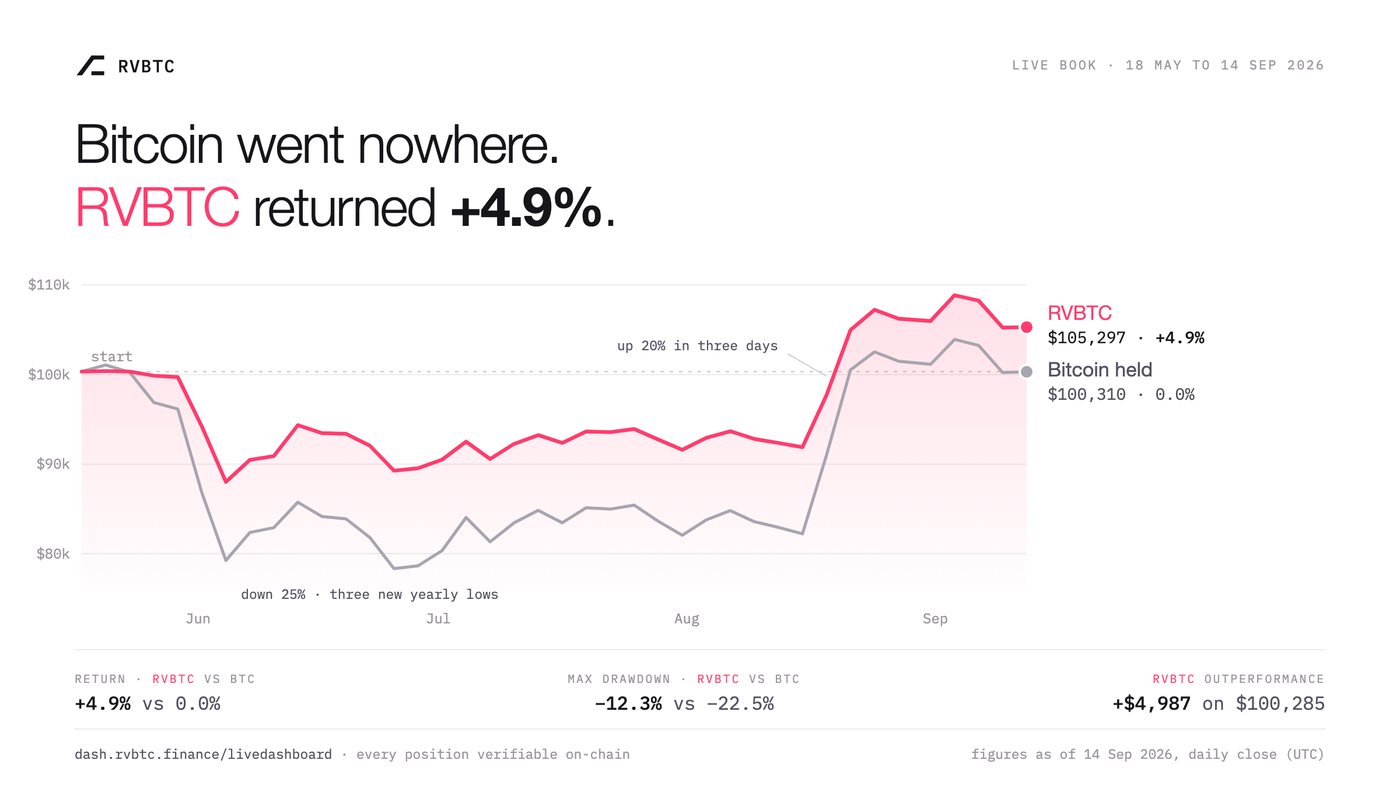
BTC went nowhere. Nobody enjoyed the trip. RVBTC earned 4.9% anyway.
On 18 May we quietly put a strategy live with real money. Since that day Bitcoin has fallen by roughly a quarter, staged one of the fastest three-day rallies in its recent history, and spent September drifting lower. As of 14 September, Bitcoin closed within a fraction of a percent of where it started: four months of violence, and the price ended where it began.
Nobody who lived through those four months would call them nothing.
Maybe you were waiting to allocate. The decision had been made in principle in the spring, with Bitcoin near $83,000: the position made sense, the size was agreed, and the entry was left to judgment, to be executed on weakness. The weakness duly arrived. A new low for the year near $59,000 on 5 June, another near $58,000 on the 25th, and a third new low at $57,750 on 1 July. Three new lows in four weeks, and each one made waiting look like discipline: why commit at $59,000 when the trend says $55,000 is coming? It never came. The market built a base, moved sideways through the summer, and then, over 19 to 21 August, repriced from the mid-$60,000s to above $78,000 in three days. The approved allocation still sits unexecuted, and building the position today costs some 33% more than the levels that were available, three separate times, to a buyer who had already decided to buy. That is the quiet arithmetic of opportunity cost: being right about the asset and unallocated anyway.
Or the position was already on the books. Then June's 30% drawdown arrived, and with it everything a drawdown actually consists of for a professional: the mark in the monthly report, the client asking whether anything has changed, the same thesis defended a second time at lower prices. August repaid the patience in three days, and September has been taking it back. Through the whole round trip, one thing stayed constant: a position sized at a few percent of the portfolio consumed half the conversation. Volatility charges professionals in attention and governance, not only in marks.
None of this was mismanagement. It is what Bitcoin does to careful allocators, because it offers only two options: full exposure, with everything that implies, or none, trying to time a door that opens without warning. Four months of stomach-turning motion, and holding paid nothing for enduring all of it.
So it is worth asking what a third option would look like. Probably something like this: always invested, so no rally can run away from it. Buying declines at levels fixed in advance, so a falling price becomes a series of entries rather than a test of character. Carrying insurance that is restored to full strength whenever the market falls and reduced step by step as it recovers, so the fastest declines, the ones that do the real damage, are met with protection already in place. And earning fees from the motion itself, so a market going nowhere still pays for the patience it consumes.
These principles are not secrets; any experienced allocator recognizes every one of them. What is rare is executing them on an asset that trades every hour of every night, can move 20% in three days, and does its worst damage precisely when no one is at their desk. Buying the fall means acting while the news is at its worst. Reducing into the rally means acting while everyone around you is celebrating. And the insurance only works if it is kept at the size the rules demand as the market moves. Discipline, it turns out, is not a personality trait. It is infrastructure.
Running these rules is what we do, and the four-month round trip was the first real test. The numbers:
What happened.
The rules bought the June decline at pre-set levels, carried the position hedged through the recovery, shed the hedge step by step through the August squeeze, and earned fees from every leg of the motion: some $2,850 in liquidity fees and $636 in funding income, against $448 of borrowing costs, for roughly $3,040 of net fee income since inception (9.56% APY), from a market that finished flat. The full scoreline over the round trip: RVBTC +4.9%, BTC 0.0%. The $100,285 invested on 18 May stands at $105,297 in RVBTC, against $100,310 had it simply been held in BTC.
What were the biggest risks.
Measured from the 18 May start on daily closes, June took RVBTC down 12.3% at its worst, against 22.5% for BTC held outright. That is the insurance working, not the absence of pain: the drawdown was still real, just half as deep. August showed the other side of the same trade: insurance gives back part of a sharp rally, and RVBTC finished the month slightly behind BTC. Half of BTC's downside costs a slice of its upside. We consider that a fair trade, and we publish both sides of it.
What was the resolution.
BTC, over the four months: 0.0%. RVBTC: +4.9%, with 1.3110 BTC of exposure versus the 1.3069 a holder would have, and the coins in the client's own custody the entire time.
The takeaway.
Bitcoin just spent four months paying a holder nothing for enduring everything. RVBTC ran the same four months by rules and returned 4.9%. Every position behind these numbers is verifiable on-chain, today and any day: live dashboard