Ask what actually kills most crypto strategies, and the honest answer is rarely being wrong about Bitcoin's price. It is leverage. Every crash fills the same graveyard: borrowed positions, force-sold by the lender at the worst possible moment, with no say from the trader who opened them.
RVBTC is a rules-based strategy built to outperform simply holding Bitcoin, in part by borrowing against the Bitcoin it holds. So it owes a clear, verifiable answer to the obvious question: what stops it from ending up in that same graveyard? This is that answer, with the live numbers behind it.
Why RVBTC borrows at all
RVBTC keeps its Bitcoin in Aave, a lending protocol, posted there as collateral the way a homeowner posts a house against a mortgage. Against that collateral, RVBTC borrows stablecoins (dollar-pegged tokens).
Those borrowed dollars are not a bigger bet on Bitcoin's direction. They flow into an automated Uniswap liquidity position, the same one that purchases more Bitcoin on every decline and trims into every rally at levels fixed in advance. That position also earns trading fees from other people's swaps the entire time it sits there.
In plain terms: RVBTC borrows to buy more Bitcoin when it is cheap, and that borrowed capital earns income while it waits for the next move. It does not borrow to bet bigger.
How much RVBTC is allowed to borrow
Loan-to-value (LTV) is one simple ratio: how much is borrowed compared to how much Bitcoin sits behind it. If there is $100 of Bitcoin in the vault and $40 is borrowed against it, the LTV is 40%.
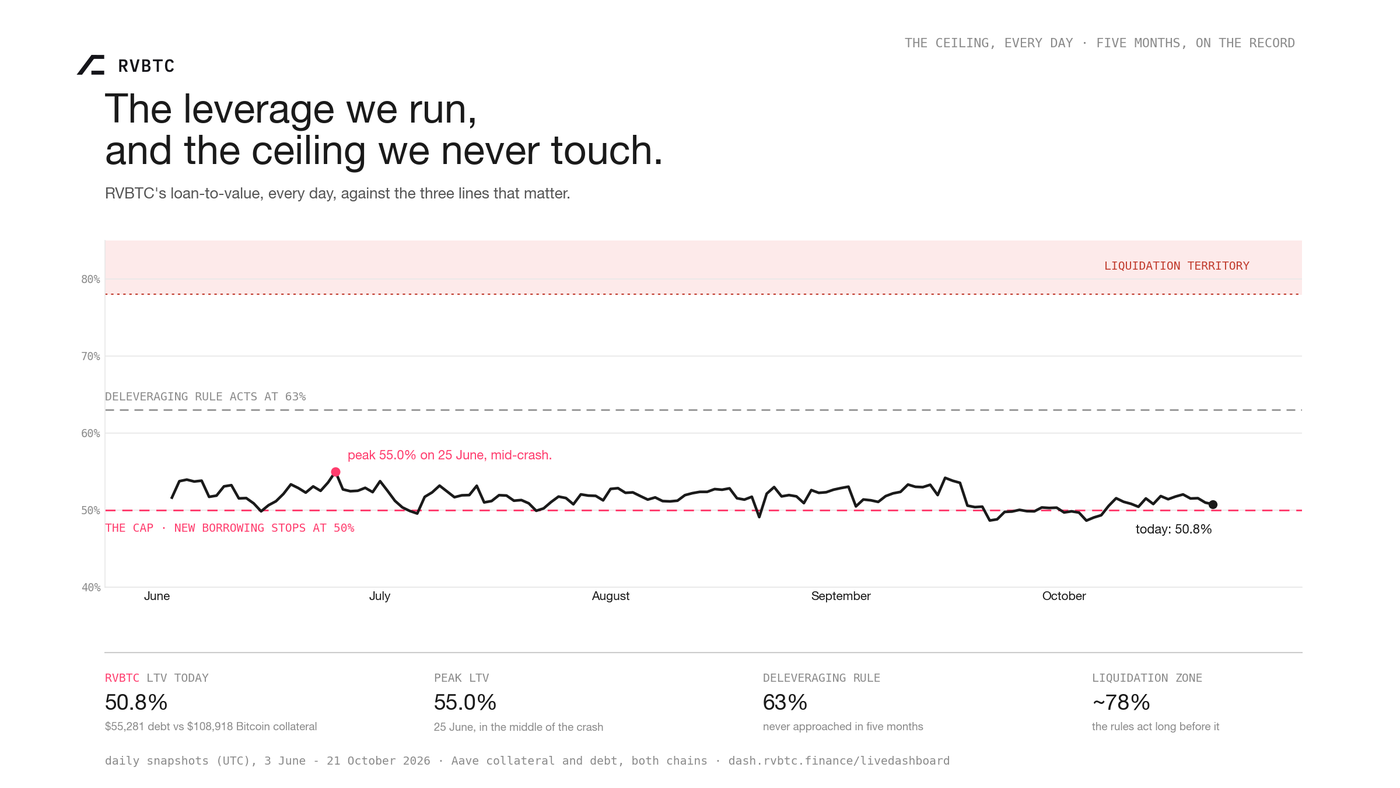
RVBTC's rule is just as simple: the loan never exceeds 50% of the Bitcoin backing it. Half, at most, set in advance, not judged in the moment.
For context, the positions that blow up almost every cycle are leveraged the other way. Perpetual futures traders borrow 10 to 20 times their collateral, where a 5 to 10% move against them wipes the position out completely.
RVBTC's structure can absorb a Bitcoin decline of roughly a third before its own rules even begin to act. An automatic deleveraging rule trims the loan back well before any danger zone is reached.
What happens to the loan when Bitcoin's price falls
Here is the part most people get wrong: they assume a leveraged position's debt only grows more dangerous as the market falls. RVBTC is built so three things happen instead:
- New borrowing stops, the moment the ceiling is reached.
- The short hedge on Hyperliquid, a separate position that gains value as Bitcoin falls, is already sized at its full amount. Its gains pay the loan down first, before anything else happens.
- A deleveraging rule cuts the loan automatically if the ratio ever climbs too close to the edge.
You can watch this live right now. Bitcoin has drifted lower through October, and with the collateral worth less in dollar terms, RVBTC's loan-to-value has risen to 51.0%, just above the 50% target: $55,269 of debt against $108,434 of Bitcoin collateral (RVBTC live dashboard).
That is not the ceiling failing. It is the ceiling doing its job: new borrowing has stopped, and the next round of hedge gains brings the ratio back under the line. A rule you can watch being enforced in real time is worth more than a promise in a pitch deck.
What it costs RVBTC to borrow
Borrowing is not free. RVBTC's loan currently carries a variable borrow rate of about 4.0% APY on Aave (debt-weighted across both chains, read live from Aave on 19 October 2026), posted in the same public ledger as the fees and funding income it earns (RVBTC live dashboard).
In a long, grinding decline, RVBTC keeps buying more Bitcoin, partly with borrowed money, all the way down. That is the design, and it is exactly why the ceiling and the hedge exist alongside it: so the one scenario that has killed every other leveraged strategy never gets the chance to kill this one.
The takeaway
It turns out leverage itself is not what blows up strategies. Leverage with no ceiling is. RVBTC's ceiling is fixed at half the Bitcoin's value, enforced by rules rather than discretion, and visible on-chain at any moment.
That is exactly why this leverage is built for long investment horizons, not short ones. It is patient enough to compound through full market cycles. It is structured so a single violent move can never force RVBTC out of its own position, and it is aimed at outperforming a simple Bitcoin holding over time, without ever being the thing that gets RVBTC blown out.
Every RVBTC number above is verifiable on-chain, in real time: dash.rvbtc.finance/livedashboard