The most important price for Bitcoin this week is not Bitcoin's. It is oil.
Not because oil replaces the Bitcoin thesis, and not because one barrel of crude explains every tick in crypto. It matters because oil is the part of inflation that central banks cannot talk away. You can argue that shelter inflation is lagging. You can argue that goods inflation is cooling. You cannot argue with the number on the gasoline sign.
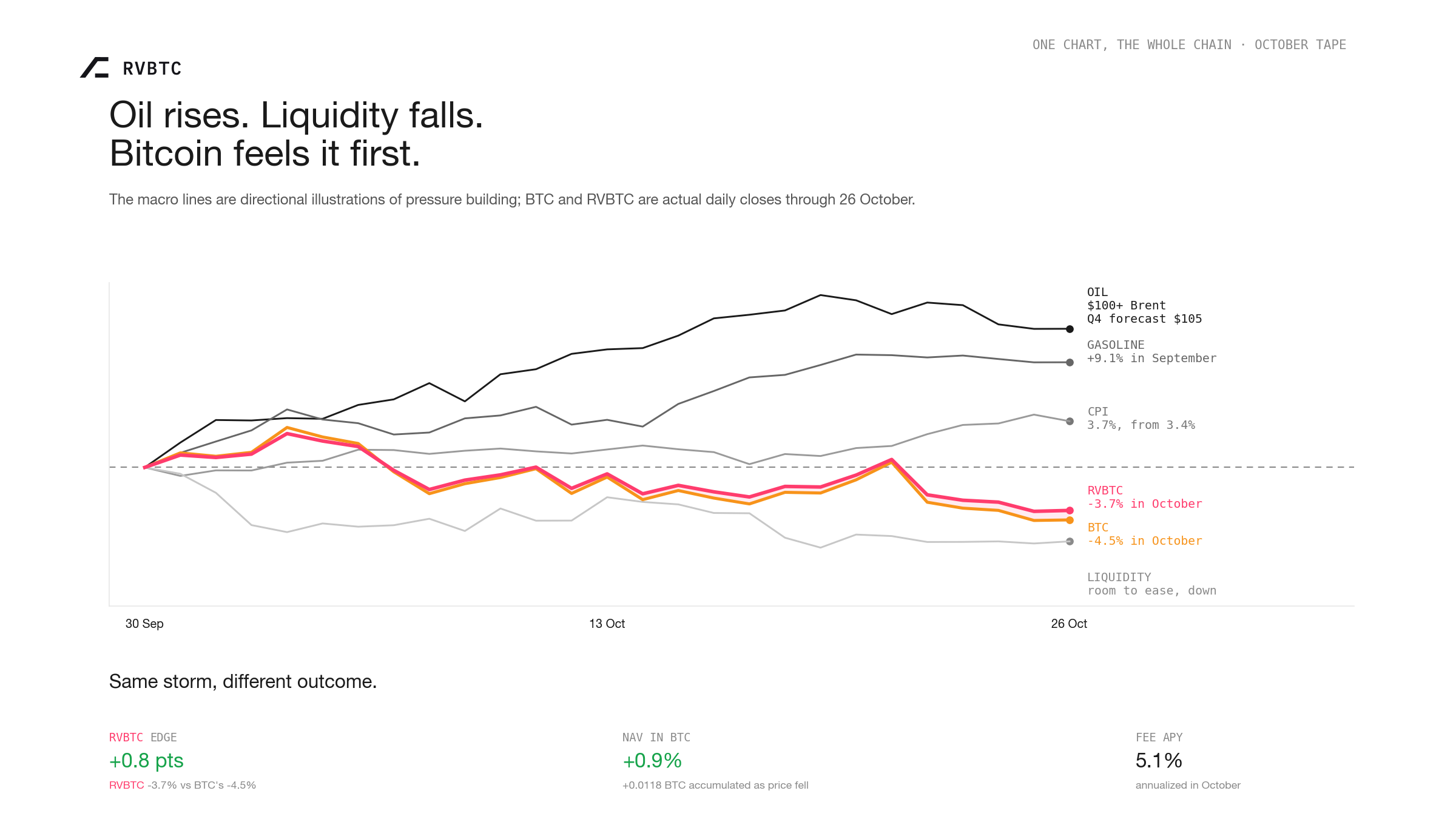
That number is now doing macro damage. Brent crude moved back above $100 in mid-September, and the U.S. Energy Information Administration now expects Brent to average $105 a barrel in the fourth quarter, $14 higher than its previous forecast (EIA, Short-Term Energy Outlook; EIA, Today in Energy).
In the United States, September CPI rose 0.6% on the month and 3.7% from a year earlier. Gasoline rose 9.1% in September alone and accounted for more than half of the monthly increase. Over the year, gasoline prices are up 34.2% (BLS CPI, September 2026; BLS CPI home).
This is why the Fed meets on October 27 and 28 with a problem it did not want (Federal Reserve FOMC calendar). Energy inflation is not the whole inflation story, but it is the part that keeps headline inflation politically and economically loud. A central bank can look through a noisy month. It has a harder time easing while fuel costs are pushing the headline number back up.
The chain is simple, and that is what makes it dangerous
The short-term chain looks like this:
Oil rises. Gasoline follows. Headline inflation firms up. The Fed sounds less free to cut, or more willing to hike. Real yields stay heavy. The dollar stays supported. Liquidity gets more expensive. Risk assets lose altitude.
Bitcoin sits inside that chain whether Bitcoin holders like it or not.
There is a longer-term argument that Bitcoin benefits when governments and central banks are trapped between inflation and debt. That argument may still prove right. But the first reaction to an oil shock is usually not "buy the scarce asset." The first reaction is "reduce exposure to anything that needs easy money." Bitcoin still trades that way when liquidity tightens fast.
This is the uncomfortable part of the inflation-hedge story. Bitcoin can be the answer to the long-term problem and still be one of the assets that gets sold while the problem is arriving.
October didn't crash. It did something worse.
October has not been a panic month. It has been a grinding month, which is often worse for discipline.
Bitcoin ended September at $83,603. By October 26 it was $79,805, down 4.5% for the month, with one failed rally to $83,980 on October 21 in between.
That is the kind of tape that does not force a dramatic decision. It just keeps asking the same question every day: why are you still holding this?
That question is where most Bitcoin exposure dies. Not always in a crash. Often in a stretch of lower highs, hot inflation, hawkish central bankers, and a market that stops rewarding patience.
The same October. A different result.
RVBTC is not immune to this. It is long Bitcoin. If Bitcoin has a bad month, RVBTC feels it. The design goal is different: lose less when the market presses down, keep buying weakness by rule, keep earning while price chops, and keep compounding when the market turns back up.
In the same September 30 to October 26 window, RVBTC's NAV moved from $114,562 to $110,298, down 3.7%, a smaller drawdown than Bitcoin's 4.5% over the same stretch.
Underneath that smaller loss, the strategy was doing exactly what it is built to do. In the active Uniswap position, the BTC leg rose from about 0.184 BTC on October 16 to about 0.233 BTC on October 26 as price moved lower through the range. When the market sells into the range, RVBTC ends up holding more Bitcoin and fewer dollars. That is not a consolation prize. It is the mechanism converting a falling price into a bigger Bitcoin position, automatically, while a simple holder's coin count stayed exactly the same.
The hedge kept paying its carry too. October fee income is running at a 5.1% annualized rate, slower than September's 7.95% pace, but still positive in a month when simply holding Bitcoin paid nothing.
That is the trade RVBTC is built around. If oil breaks lower, inflation cools, and Bitcoin rips upward, RVBTC rides the move while the liquidity position and the banked Bitcoin keep working. If oil stays high and the market keeps bleeding, RVBTC loses less, buys lower, and keeps collecting income either way. Not a lottery ticket on one rally. A mechanism built to finish the cycle with more Bitcoin than holding alone.
That is what October shows.
Because the real question raised by $100 oil is not whether Bitcoin has a long-term place in a portfolio. It is whether the way you hold Bitcoin can survive the short-term part: the inflation print, the Fed meeting, the failed rally, the slow leak lower, and the boredom that makes disciplined people do undisciplined things.
Oil does not need to stay high forever to cause damage. It only needs to stay high long enough to keep the Fed uncomfortable.
That is the environment RVBTC was built for. Not euphoria. Not collapse. The long middle, where the market stops entertaining you and starts charging you rent.
Live position, every day: dash.rvbtc.finance/livedashboard