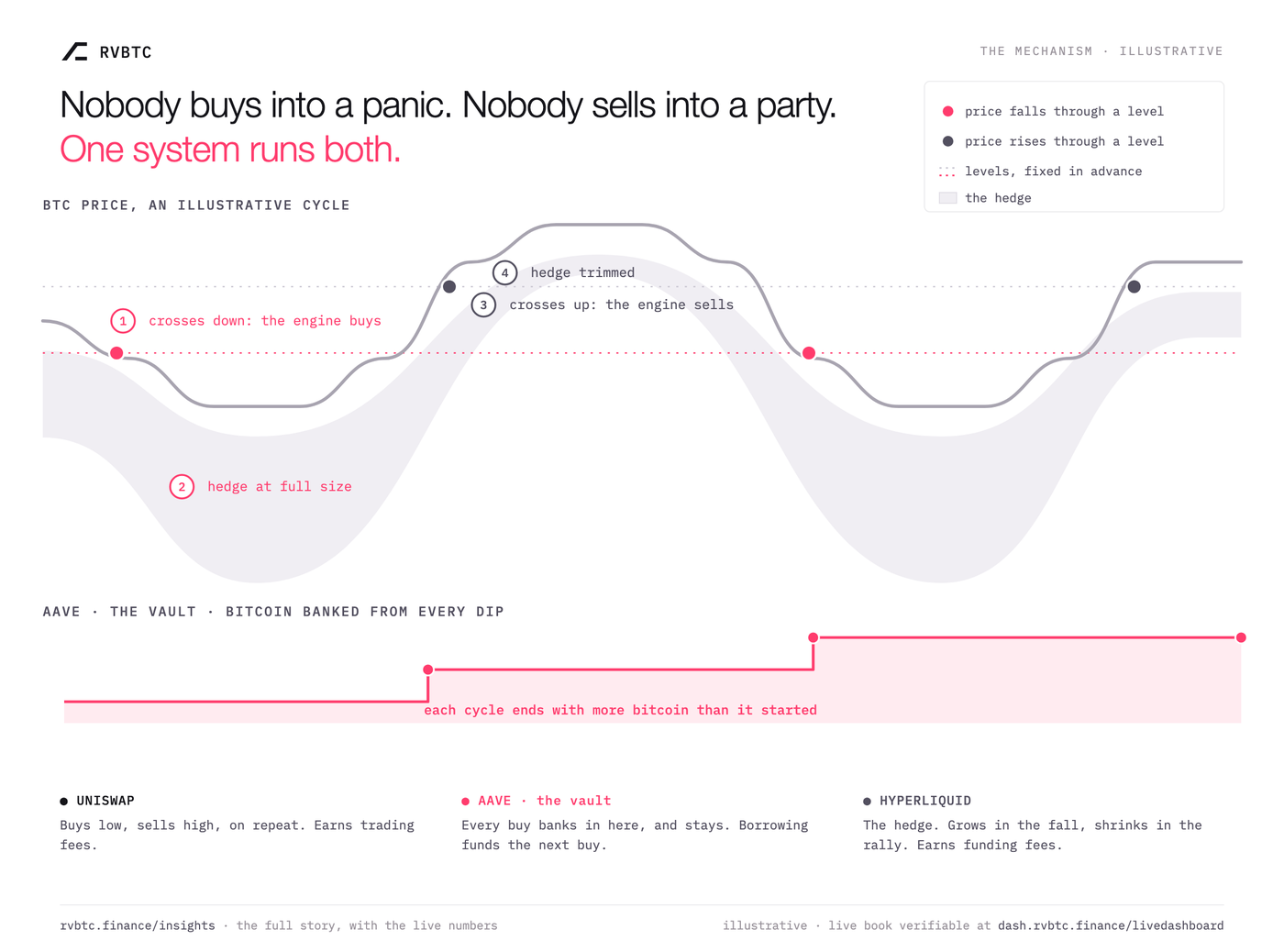
Cast your mind back to June. Bitcoin set a new low for the year near $59,000 on the 5th, another near $58,000 on the 25th, a third at $57,750 on 1 July. Every feed was declaring Bitcoin dead. Buying then was not a decision anyone felt like; it was a decision to be made alone, at night, against the trend, against the news, against your own pulse. Almost nobody made it.
Now look at the other side. August repriced Bitcoin from the mid-$60,000s to above $78,000 in three days, and September has pushed past $86,000. Sentiment is euphoric again. And at a party like this, selling feels just as unnatural as buying felt in June: every instinct and every headline says hold on for more. So holders hold, nothing gets banked, and if the cycle turns, the untouched position rides it all the way back down.
Panic and euphoria are opposites, but they charge the same toll: they make the right action feel exactly wrong at the moment it matters. Our approach is to stop treating either one as a decision. Here is how the machinery actually works.
The engine: a liquidity position that trades both ways.
Part of the book sits in a concentrated liquidity position on Uniswap, set around market price at the moment it is created. From then on the price moves through the position, and the position trades automatically: as the price falls, it buys Bitcoin, coin by coin; as the price rises, it sells Bitcoin back into the strength. Every swap that passes through earns the position a trading fee, in both directions. There is no moment where someone has to pull a trigger, so there is no trigger that can be hesitated over.
The vault: where bought Bitcoin goes to work.
When a decline carries through a level fixed in advance, the book buys a defined amount of Bitcoin and banks it. Banking means the coins move into the book's vault on Aave, where they serve as collateral. The book then borrows conservatively against that collateral, and the borrowed capital funds the liquidity position. So the same Bitcoin does two jobs at once: it sits in the vault as long-term exposure, riding whatever the market does next, and it backs the engine that keeps earning fees and buying more Bitcoin.
The hedge: insurance that adjusts with the weather.
Behind it all stands a short hedge. When the market falls, the hedge is kept at the size the rules set for it, so when the fastest declines arrive, the ones that do the real damage, the protection is already in place and paying out. The borrowing, meanwhile, is held on a short leash: the loan never exceeds 50% of the value of the collateral behind it, and if a crash outruns everything else, the rules require the debt to be cut back before it can threaten the position. If the market rises instead, the hedge is trimmed at predetermined levels, step by step, so the book captures more of the move up.
What a rally actually does to the book.
This is the part people get wrong, so it is worth spelling out. A price increase does not mean the book sells its Bitcoin. The Bitcoin in the vault rides the wave in full. Only the liquidity position sells, and only gradually, as the rising price moves through it, converting Bitcoin into cash at better and better prices while collecting fees along the way. Meanwhile three things happen at the predetermined levels: the short hedge is trimmed, so more of the rally is captured; the vault's collateral is now worth more, so the book borrows more against it; and that new borrowing goes into the same liquidity pool and makes it bigger, so it earns more fees and stands ready to buy the next dip in larger size. The rally, in other words, is what reloads the buying.
What this produced.
From the 18 May start through the close of 21 September, RVBTC returned +17.1% against +12.6% for simply holding BTC over the same stretch. The $100,285 invested in RVBTC stands at $117,483, against $112,935 had it been held in BTC. Measured the way we care about most, in coins: RVBTC holds 1.3110 BTC of exposure versus the 1.3062 a holder would have. That gap is small right now, by design. It grows only when Bitcoin declines, and Bitcoin, being Bitcoin, will decline again. When it does, the Bitcoin count grows: the rule is to buy the dip and bank it, so every decline RVBTC weathers leaves it holding more Bitcoin than the one before.
The whole cycle, short version.
When the price falls:
- The engine gradually buys Bitcoin.
- Every swap through the position earns a fee.
- At a predetermined level set by the rules, more Bitcoin is bought and banked in the vault.
- The vault backs new borrowing, within the 50% loan-to-value limit.
- The hedge stands at full rule-set size, absorbing the fall.
When the price rises:
- The engine gradually sells into the strength.
- Every swap through the position earns a fee.
- At each level, the hedge is trimmed, capturing more of the move up.
- The vault's collateral is worth more, so borrowing power grows.
- The new borrowing expands the engine, ready to buy the next dip.
Each turn of the wheel is built to leave the book with more Bitcoin than the turn before. That is the entire strategy; everything else is discipline and plumbing.
The takeaway.
The best time to buy Bitcoin is when everyone is afraid, and the best time to sell is when everyone is celebrating. We removed both moments from the realm of willpower and wrote them into mechanism. Every step above runs on-chain and can be verified, trade by trade, on the live dashboard.