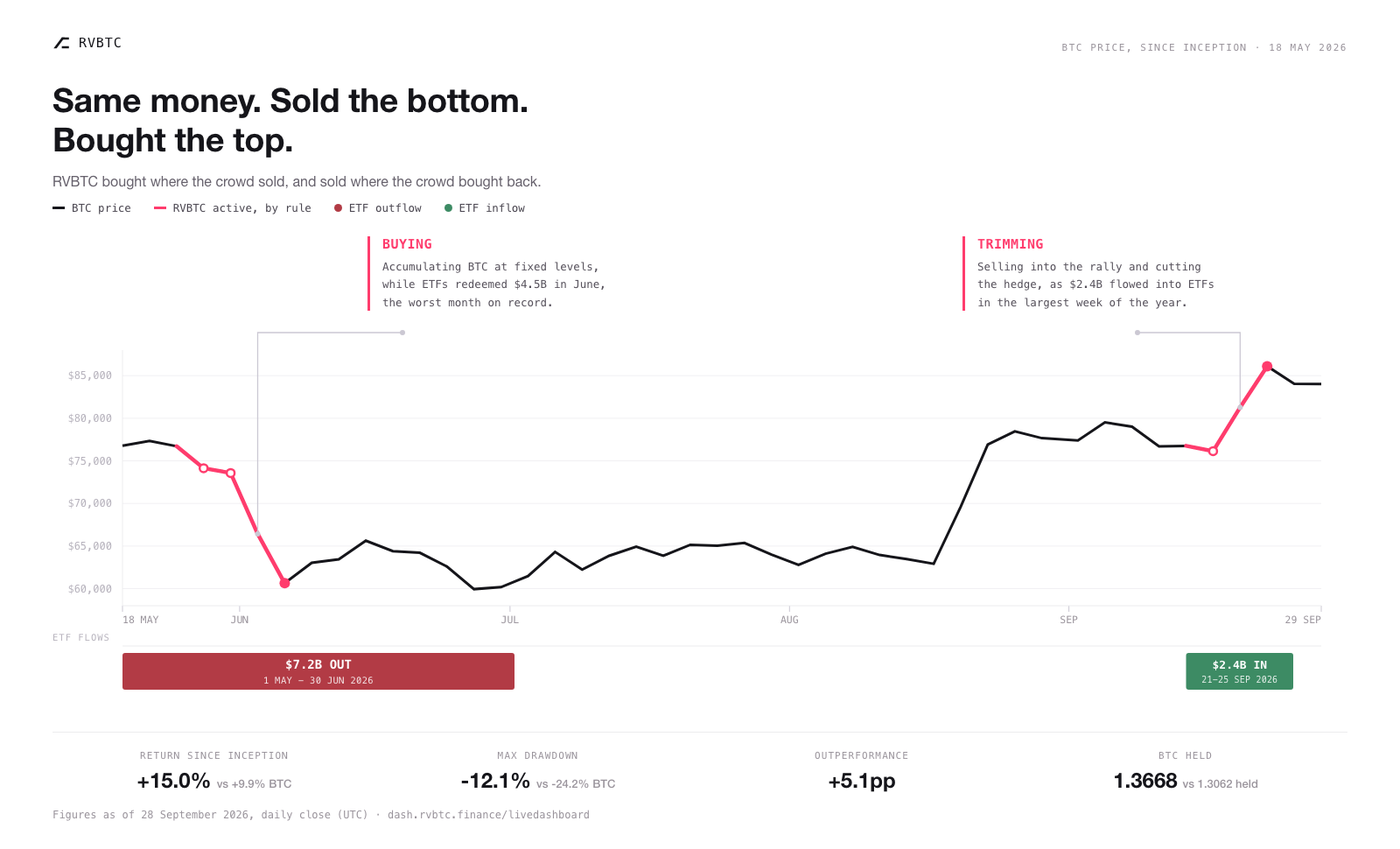
According to TFTC, something happened on Monday, 21 September that had not happened all year: nearly a billion dollars flowed into US spot Bitcoin ETFs in a single session, $999.0 million, the largest single-day intake of 2026. BlackRock's IBIT took $381.4 million, ARKB $289.1 million, Fidelity's FBTC $238.8 million, per the same data. By Friday, the week's total stood at $2.39 billion, enough to push 2026 flows positive for the year for the first time since April, according to Galaxy's Alex Thorn, speaking to InvestingLive.
The headlines read it as vindication. The institutions are back. Read one layer deeper, and it is something more useful: a receipt, and it names the other side of the trade.
What the receipt shows.
To see what that $2.4 billion bought, rewind six months. Over May and June, those same ETF wrappers suffered their two longest streaks since launch, back to back, draining an estimated $7.2 billion and pushing 2026 year-to-date flows negative for the first time this year (TFTC, per SoSoValue data). June alone was the worst month of redemptions on record, $4.5 billion (TFTC monthly archive), and it was also the month the Federal Reserve turned. Chair Kevin Warsh used his first FOMC meeting, on 17 June, to take rate cuts off the table and put hikes on it; Bitcoin fell below $64,000 within hours, per Digitap. By 16 September the Fed had carried through: a 25 basis point hike to 3.75-4.00%, the first since July 2023, per the FOMC's own statement.
Sell fear, buy relief, the oldest trade in markets.
The largest pool of professional money in this market sold through that decline, at prices that slid from around $91,000 in January to lows near $57,750 by early July. Then, in the third week of September, it paid $2.4 billion to buy back in at $81,000 to $87,000, still roughly a third below the October 2025 all-time high of $126,198. It is usually told as a story about retail investors. The 2026 flow data says otherwise. The wrapper is institutional, the tickets are nine figures, the hands are the same human hands.
The wrapper does not change the hands.
There is a comforting belief that putting Bitcoin inside a ticker symbol professionalizes the holding of it. This year tested that belief in public. When the drawdown came, the wrapper did not hold steadier than anyone else. It sold, in size, for six months. When the recovery came, it bought back, in size, in one week. The ticker changed nothing about the trade. It only made the trade easier to measure.
None of this is stupidity. It is structure. Money that can leave at the click of a button tends to leave at the wrong moment, because the person behind the button is reading the same headlines as everyone else. If you advise clients, you have watched this. If you invest, you have felt the pull yourself.
The other side of that flow.
While the wrappers were selling in June, RVBTC was buying. Not from a view on the Fed, and not from courage. Price crossed down through levels fixed in advance, and the mechanism bought, the same way it always does. When the inflows returned in September and price climbed back through those levels, RVBTC sold into the rally and trimmed its hedge, capturing the move the late money was chasing.
Same market. Opposite side of the trade, taken by rule at both ends.
And there is a second, quieter way the round trip pays us. Every panic sale and every hurried buy that crosses a liquidity pool pays a fee to whoever provides the liquidity. RVBTC is the liquidity. Since 18 May, the position has collected $3,549 in net fees, a 10.0% annualized rate on RVBTC's value, much of it earned from exactly this kind of two-way flow, verifiable on the live dashboard. The herd's round trip is RVBTC's revenue.
The honest footnote.
Speaking to InvestingLive, Thorn flagged the caveat that matters: part of September's inflow was forced buying from closed short positions, and the real test is whether the money keeps arriving now that the shorts are gone. If it does not, price sags and RVBTC would draw down with it. Hedged, not immune. We publish that the same way we publish the good months.
What the record shows so far, from 18 May through 28 September
RVBTC returned +15.0% against +9.9% for simply holding Bitcoin, with a worst drawdown of -12.1% against -24.2% for holding, and more Bitcoin in the vault than holding would have left, 1.3668 against 1.3062, per the live dashboard.
The next time someone tells you the institutions are coming, ask where they were in June. Then decide whose side of their flow you would rather be on.
Every RVBTC number above is verifiable on-chain, in real time: dash.rvbtc.finance/livedashboard