The question comes up almost every week. In late September, with Bitcoin back near $87,000 and social media celebrating another rally, it came in a simple form: "You hold Bitcoin, so why are you short Bitcoin?"
Yes. We do it on purpose, by fixed rules, in a size you can check. This post explains why, and what it costs us, because the cost is the part most managers would rather you not ask about.
What a short actually is
RVBTC holds Bitcoin. It buys on declines, keeps the coins as collateral, and never sells them. Alongside those coins, it runs a short position on Hyperliquid, an exchange for perpetual futures.
A perpetual future is a contract that follows Bitcoin's price and never expires. A short position earns when Bitcoin's price falls and loses when it rises, dollar for dollar. It works as a counterweight: when the market drops, the short wins back a slice of what the coins lose.
The size is not a judgment call. The rules fix it in advance. When the market falls, the short stands at its full set size and absorbs part of the drop. When the market rises, it is reduced at set price levels, step by step, so more of the rally goes to RVBTC each time.
While it runs, it also earns. Perpetual futures carry funding: a small payment exchanged between buyers and sellers every hour, which keeps the contract's price close to Bitcoin's real price. When the crowd piles into buying, the buyers pay the sellers. Since May, funding alone has paid RVBTC $739 (as of 1 October). The crowd pays for its own enthusiasm, and we are on the collecting side.
What it costs
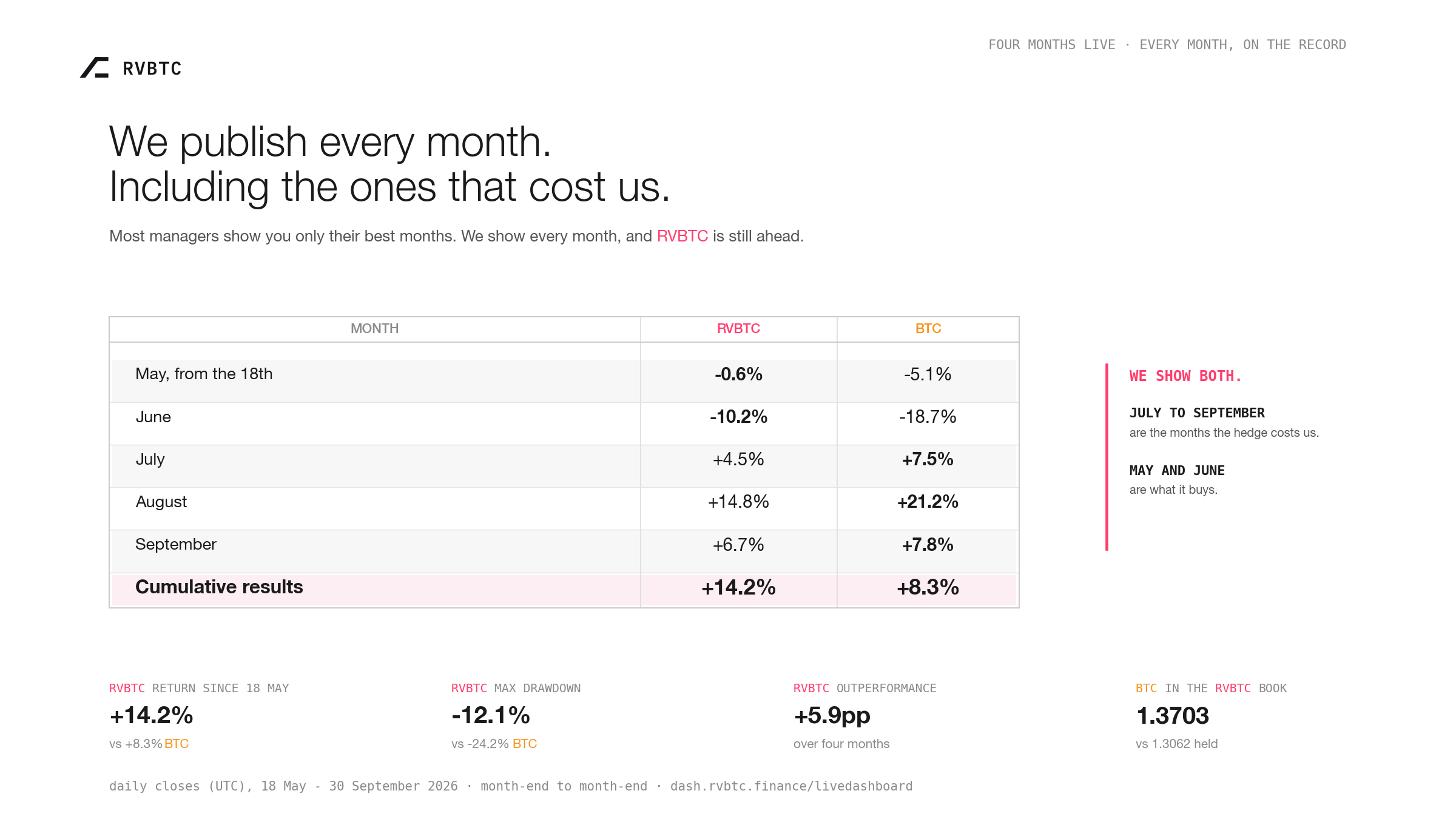
In August, Bitcoin rose 21.2%, most of it in about a week. RVBTC rose 14.8% over the same month. The six-point gap is the cost of the hedge: roughly a third of the move, given up in a single strong month. July and September told the same story on a smaller scale: Bitcoin +7.5% and +7.8%, RVBTC +4.5% and +6.7%. When the market runs, the hedge tolls. Every month is on the live dashboard, unhidden.
Here is why that cost exists. The short is insurance against a fall, and insurance is never free. It is sized against only part of RVBTC's holdings, so a rally still pays well. But while the short is open, every dollar it loses in a rising market is upside handed back. The rules reduce it at set price levels, on a schedule set in advance rather than by the market. In a fast, one-way rally, the market moves faster than that schedule. That gap is the price of being protected on the way down, and we publish it the same way we publish the wins.
What it buys
Survival, in the sense that matters to a long-term holder.
From 18 May through 30 September, RVBTC's worst drop from a peak was -12.1%. Simply holding Bitcoin through the same period: -24.2%. Half the loss. That is not a comfort number. It is the difference between a position you can hold through a rough patch and one that gets sold at the bottom, by nerves, by borrowed money, or by life getting in the way.
Every long-term Bitcoin holder thinks in decades. The real threat to a position like that is rarely one bad year. It is the forced exit: the emergency, the panic sale, the moment a 60% drop collides with a tuition bill. The hedge is meant to keep a sharp drop from forcing a sale at the bottom.
There is a second benefit, and it works as the price falls. When the price drops to a new level, the short's gains are first used to pay down the loan. Whatever is left goes into the liquidity position, which buys Bitcoin as the price keeps falling and banks it in the vault. By rule, the protection doesn't just cushion a fall; it turns part of the fall into more Bitcoin.
The objection, answered honestly
"Shorting Bitcoin is a bet against Bitcoin." It would be, if the short replaced the coins. It doesn't. It sits next to them, is sized against them, and shrinks as the price rises.
The clearest proof is the one number that can't be argued with. RVBTC's position equals 1.3703 BTC. Simply holding would have left you with 1.3062 BTC, from the same starting dollars through the same market (live dashboard, 30 September 2026).
A bet against Bitcoin would leave you with less of it. We are long Bitcoin with the volatility turned down.
The record
From 18 May through 30 September, RVBTC returned +14.2%, against +8.3% for simply holding BTC. It did so with half the worst drop, more Bitcoin than holding would have left, and $3,591 of net fee income on top: a 9.9% annualized rate on RVBTC's value.
Hedged, not immune. The short is a bet against Bitcoin in the narrow sense. Its job is to let your Bitcoin holdings survive to 2040 and beyond.
Every position above is verifiable on-chain, in real time: dash.rvbtc.finance/livedashboard